

03.04.2025.
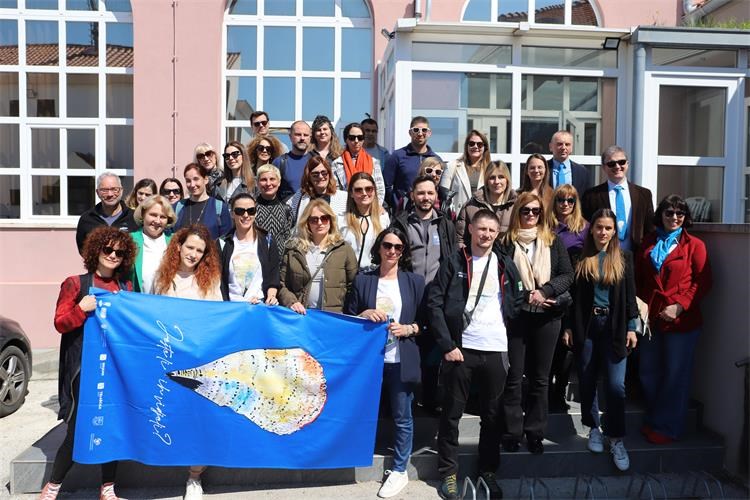
In Nin, the annual meeting of the partners of the Noble Pen Shell (Pinna nobilis) conservation project in the Adriatic Sea was held. The meeting gathered over 50 representatives of the scientific and professional community from Croatia, Slovenia, Italy, and Spain, who reviewed the results achieved so far, exchanged the latest findings, and agreed on further steps in protecting this globally critically endangered species.In Croatia, the pen shell conservation project is coordinated by the Ministry of Environmental Protection and Green Transition and co-financed by the Environmental Protection and Energy Efficiency Fund. “The Fund co-finances these activities through three projects implemented by the Brijuni National Park Public Institution (for the northern Adriatic), the Telašćica Nature Park Public Institution (for the central Adriatic), and the Sea and Karst Public Institution (for the southern Adriatic). The goal of these projects is to identify locations and monitor surviving individuals, as well as establish in-situ and ex-situ conservation measures, including breeding pen shells in controlled conditions,” explained Vlatka Gulan Zetić, Head of Department at the Fund. Despite the significant challenges in preserving this species and the fact that this largest Mediterranean bivalve has been facing mass mortality since 2016, international cooperation, scientific research, and active citizen participation provide hope for the future of the noble pen shell.
It is believed that the die-off is primarily caused by the parasite Haplosporidium pinnae, although viral infections and climate change - specifically rising sea temperatures - also play a role. At the meeting, scientists emphasized that the rare surviving individuals are mostly found in lagoons, where specific environmental conditions appear to support their survival. However, in the Croatian part of the Adriatic, such cases are rare, and habitats are highly endangered, so today only eight confirmed live noble pen shell individuals remain. Given the decreasing number of live specimens in the sea, the survival of the species critically depends on finding potentially resistant individuals that could reproduce and create natural “immunity.” In this regard, every surviving individual is a valuable source of information, and it is important to stress that only through joint efforts can the conservation of this important species and the entire Adriatic ecosystem be achieved.
This is why the campaign “Have You Seen Them?” remains a key tool for identifying surviving individuals, allowing citizens to contribute to the conservation of this endangered species by reporting sightings.
- If a noble pen shell suspected to be alive is observed, one should gently pass a hand through the water above it; a living noble pen shell will close. Care should be taken not to touch or disturb the specimen more than necessary. An example of the verification method is shown in a short video.