


At the site of the former PPK Velebit industrial complex in Gospić, waste was illegally dumped and buried for a number of years. The Environmental Protection and Energy Efficiency Fund, in cooperation with the Ministry of Environmental Protection and Green Transition and with the support of the Government of the Republic of Croatia, is conducting a comprehensive remediation process of the location.
The goal of the remediation is to remove the source of pollution, reduce and permanently eliminate risks to the population and the environment, prevent further transfer of pollutants, and landscape and stabilise the remediated area.
Due to the scope and complexity of the on-site condition, the remediation is being carried out in phases. The remediation plan defines two zones - a hazardous waste zone and a non-hazardous waste zone - and envisages four operational waste removal phases, along with a preliminary protective activity involving the temporary covering of the buried waste. Waste quantities have been estimated and will be verified during implementation through geodetic measurements, weighing, and additional characterisation.
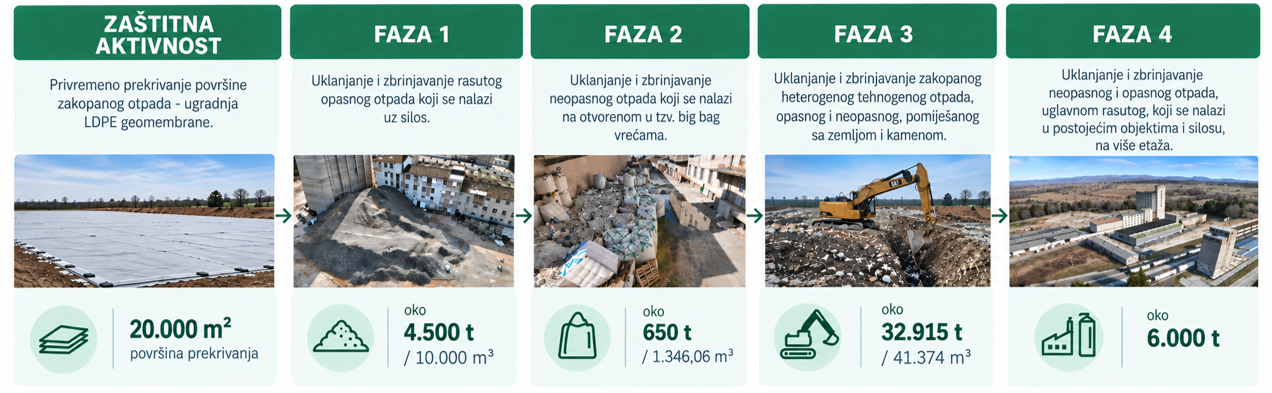
Protective Activity - Temporary covering of buried waste
Value of the temporary cover: EUR 270,000
Estimated implementation timeframe: 30 days
Current status: in progress
Phase 1 - Removal of bulk hazardous waste next to the silo
Estimated quantity: approx. 4,500 t
Estimated value: approx. EUR 8.8 million (EUR 1,950/t) + VAT
Estimated implementation timeframe: 12 months
Current status: Decision on the selection of the contractor has been made
Phase 2 - removal of non-hazardous waste in big bags
Estimated quantity: weight - approx. 650 t, volume 1,346.06 m³
Estimated value: 390,000 EUR (600 EUR/t)
Estimated implementation time: 45 days
Current status: contracted
Phase 3 - Remediation of buried waste
Estimated quantity: weight approx. 32,915 t, volume approx. 41,374 m³
Area: approx. 14,267 m²
Average depth: approx. 2.9 m
Current status: procurement procedure in preparation
Phase 4 - Removal of waste from existing facilities and silo
Depending on the properties and results of the characterisation of individual fractions, different procedures of final recovery and disposal are taken into consideration: energy recovery or incineration (R1/D10), disposal in an appropriate landfill, combination of energy recovery/incineration and disposal, and material recovery by the R3 procedure with appropriate treatment of the remaining part of the waste. .
Estimated quantity: approx. 6,000 tonnes, of which approximately 4,500 t non-hazardous waste and 1,500 t hazardous waste
Estimated value: around €6 million
Estimated removal time: up to 12 months
Estimated final treatment time: additionally up to 12 months
Remediation works will be organised in a manner that minimizes potential temporary impacts and ensures that the works themselves do not cause new or increased pollution. Protective measures will be adapted to individual phases of the remediation process.
During the remediation, environmental conditions will be continuously monitored and adjusted to the type and phase of the works.
The implementation of remediation is expected to achieve:
• removal of the pollution source
• reduction and permanent elimination of risks to the population and the environment
• prevention of further transport of pollutants
• soil stabilisation and landscaping of the remediated areas
• improvement of the landscape and environmental condition of the area
However, the physical removal of waste alone is not sufficient to confirm that the remediation is completed. The completion of remediation must be verified through control testing of the excavation base and slopes, residual soil, as well as groundwater and surface water, by documenting the removed quantities and waste streams, providing proof of handing over waste to authorised entities, and confirming that the established remediation completion criteria have been met.
- sanacija big bag vreća - rezultati analiza.zip
- 1.faza rasuti otpad uz silos - rezultati analiza.zip
- Dopuna nalaza i mišljenja vještaka zaštite okoliša za lokaciju industrijskog kompleksa Gospić, Bilajska 50.pdf
- Nalaz i mišljenje vještaka zaštite okoliša za lokaciju industrijskog kompleksa Gospić, Bilajska 50.pdf
- Dodatne Analize otpada-FAZA 2 VREĆE - FZOEU.zip


